|
|
||||||||


|
|
as CENTRAL AFRICAN REPUBLIC 1971
Five wildlife stamps, two featuring tortoises.
1973
Five wildlife stamps, two featuring tortoises. A single stamp of a Dwarf chameleon. e series featur as CENTRAL AFRICAN EMPIRE 1978
One of two stamp exhibition stamps featuring a 1960 stamp of a bird of prey with a Nile crocodile (Crocodylus niloticus) A stamp fearuring a rather poor photograph of the Narrow-snouted crocodile (Mecistops cataphractus) which was recently removed from the genus Crocodylus to its own monotypic genus. View the First Day covers for this stamp
1979
One of two stamp exhibition stamps featuring a 1960 stamp of a bird of prey with a Nile crocodile (Crocodylus niloticus) on the outer stamp.
as CENTRAL AFRICAN REPUBLIC
1981
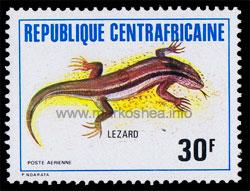
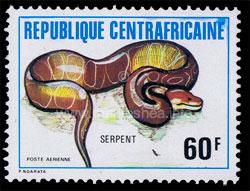
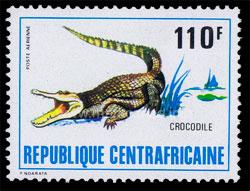
The lizard is a skink and the most likely species represented is the Spotted-lipped skink (Trachylepis maculilabris), one of several skinks in the genus present within the Central African Republic. The serpent is clearly a short, stout Royal or Ball python (Python regius) while the crocodile is a Nile crocodile (Crocodylus niloticus) although it may possibly represent the West African crocodile (C.suchus) which was recently resurrected from within the pan-African Nile crocodile for populations from West Africa.
1982
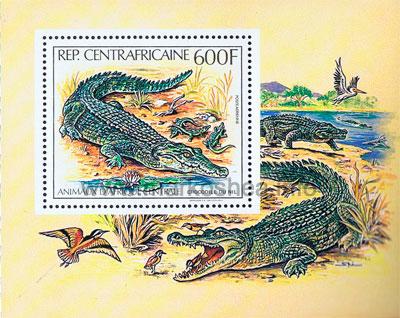
A better illustration of a Nile crocodile (Crocodylus niloticus) will offspring.
1984
One of the two stamps illustrated a wide variety of animals, including one large snake, fleeing a bushfire.
1996
One stamp is illustrated with a strange Nile crocodile (Crocodylus niloticus) against a black background.
XXXX REPTILES OF CENTRAL AFRICA
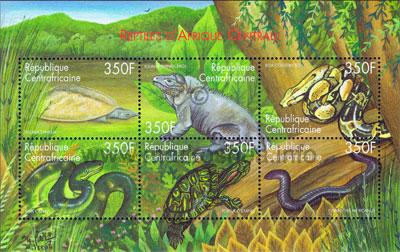
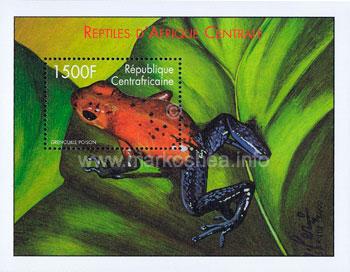
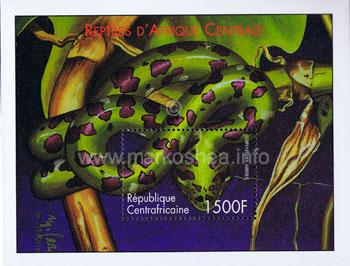
Where to start! This is a truly dreadful se-tenant set of six stamps with accompanying souvenir sheets. It purports to show "Reptiles d'Afrique Central", reptiles of Central Africa, but do the designers think everyone is a ignorant as them - there is not one single African reptile in the eight species represented, the are all from the Americas. The Spiny softshell turtle (Apalone spinifera) is North American, the caecilian (and amphibian, not even a reptile) is the Mexican caecilian (Dermophis mexicanus), curiously the only species correctly labelled, apart from the Common boa (Boa constrictor) of Central and South America, which is joined by two other S.American boas, the Emerald tree boa (Corallus caninus) and the Green anaconda (Eunectes murinus). Also present is the Rhinoceros iguana (Cyclura cornuta) from the Caribbean and another amphibian, the Strawberry dart-poison frog (Dendrobates pumilio) from Central America. These stamps everything that is wrong with themed philately, terrible illustrations (did I mention that) and incomplete or incorrect labelling.
Associated links on this site:
|
|||||||||||||||||||||||||||||||||||||||||||||||||||||||||||||||||||||||||||||||||||||||||||||||||||||||||||||||