|
|
||||||||


|
|
2001
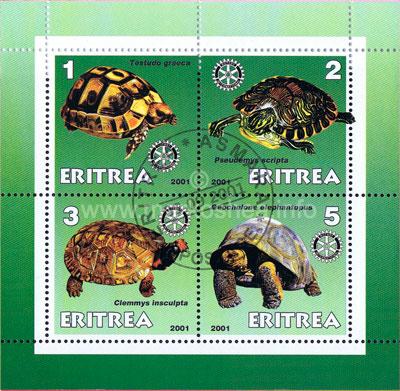
Four turtles and tortoises, on from Galapagos, one from Europe and two from the United States, and three undergone generic name changes at the time or prior to this stamp issue - lazy! And to increase sales to collectors they include the Rotary International emblem.
CROCODILIANS
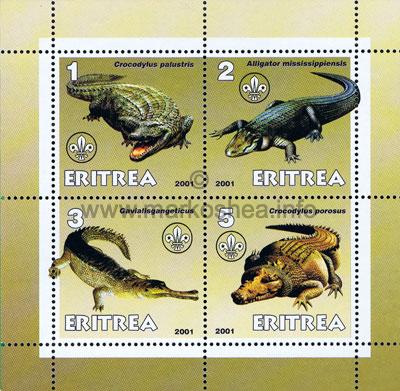
Despite Eritrea being in Africa these stamps illustrate one American and three Asian crocodilians, all accompanied by the Boy Scouts fleur-de-lis. They are so carelessly done that the scientific name of the Ganges gharial (Gavialis gangeticus) is a single word, and where have I seen that saltwater crocodile (Crocodylus porosus) image before, oh yes of an equally rubbish stamp from Bhutan!! BoyScouts fleur-de-lis incorporated for no good reason. LIZARDS
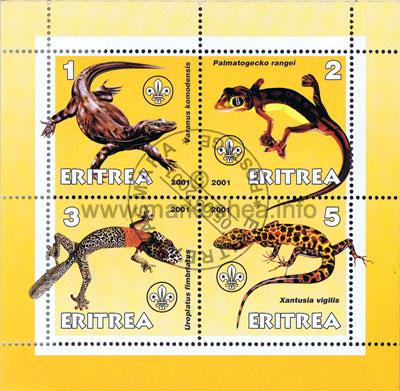
Lizards, and at last, an African species, the Namib sand gecko (Pachydactylus rangei), but it is endemicto Namibia, as from Eritrea as it is possible to get without leaving Africa. Then one Madagascan, one Indonesian and one American species make up the curious set of two geckos, a night lizard and the largest lizard in the world, the Komodo dragon (Varanus komodoensis). BoyScouts fleur-de-lis again. SNAKES
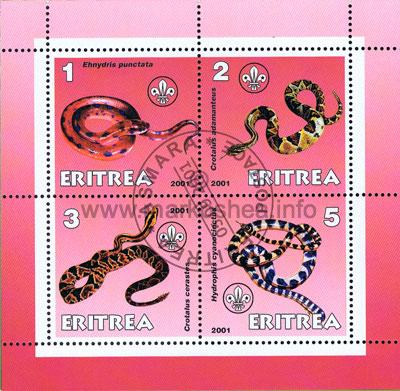
The worst set, a mis-spelled generic name for the Blackwater mudsnake (Enhydris punctata), two what appear to be Neotropical rattlesnakes (Crotalus durissus or C.simus), certainly not a Sidewinder rattlesnake (C.cerastes) and even the supposed Eastern diamondback rattlesnake (C.adamanteus) looks more like a Neotropical rattler because of the stripes on the back of the neck. Probably the only species in the entire series of four sheets that might come close to Eritrea is the Annualated seasnake (Hydrophis cyanocinctus) which certainly occurs in the northern Indian Ocean. BoyScouts fleur-de-lis again.
If postage stamps are supposed to education or advert a country to the world, the designers used by some of the countries issuing herpetological postage stamps are taking the money and not giving good service in return.
|
||||||||||||||||||||||||||||||||||||||||||||||||||||||||||||||||||||||||||||||||||||||||||||||||||||||||||||