Capital: Palikir
Population: 111,000
Languages: English
Currency: US Dollar |
|
|
|
SEA TURTLES
(SG 215-218)
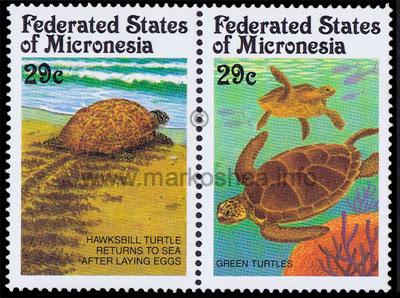 |
29c Hawksbill turtle |
29c Green turtles |
 |
50c Hawksbill turtle |
50c Leatherback turtle |
| |
Name on stamp |
Current name |
Accepted common name |
29c |
none |
Eretmochelys imbricata |
Hawksbill sea turtle |
29c |
none |
Chelonia mydas |
Green sea turtles |
59c |
none |
Eretmochelys imbricata |
Hawksbill sea turtle |
50c |
none |
Dermochelys coriacea |
Leatherback sea turtle |
A pair of attractive se-tenant paired stamps featuring three species of sea turtles.
ONE EARTH
(SG 1091)
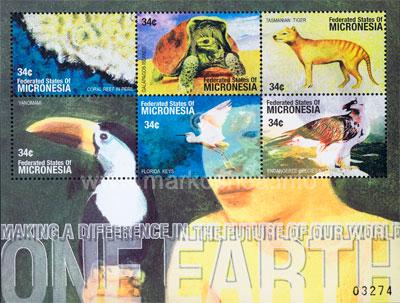 |
34c Galapagos
|
| |
Name on stamp |
Current name |
Accepted common name |
$2 |
none |
Chelonoidis nigra |
Galapagos giant tortoise |
A minisheet featuring six endangered species, places and peoples, including the Galapagos Islands illustrated by a Galapagos giant tortoise (Chelonoidis nigra).
UNDERWATER TREASURES OF MICRONESIA
(SG n/a)
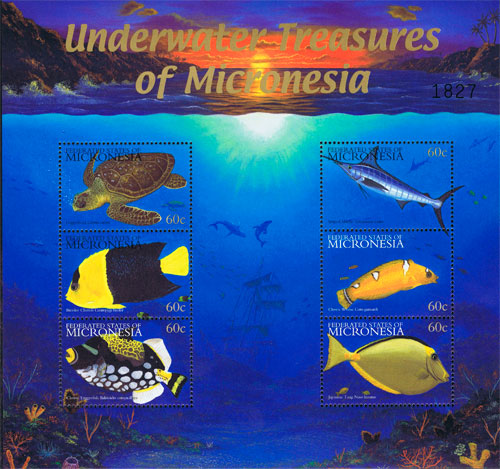 |
60c Loggerhead
Caretta caretta
|
|
| |
Name on stamp |
Current name |
Accepted common name |
$2 |
none |
Caretta caretta |
Loggerhead sea turtle |
A minisheet of marine life, featuring one turtle, a favourite of Micronesian stamps, the Loggerhead sea turtle (Caretta caretta).
REPTILES & AMPHIBIANS
(SG MS 1241)
 |
80c Leopard gecko |
80c Red-eyed tree frog |
80c Panther chameleon |
80c Green & black poison frog |
 |
$2 Madagascan chameleon
|
| |
Name on stamp |
Current name |
Accepted common name |
| 80c |
none |
Eublepharis macularius |
Leopard gecko |
| 80c |
none |
Agalychnis callidryas |
Red-eyed treefrog |
| 80c |
none |
Furcifer pardalis |
Panther chameleon |
| 80c |
none |
Dendrobates auratus |
Green & black dart-poison frog |
| minisheet |
$2 |
none |
Furcifer pardalis |
Panther chameleon |
Four nondescript herp stamps featuring species from C.America, Madagascar and West Asia, and a curious high value minisheet featuring a Malagascan chameleon, possibly a Panther chameleon (Furcifer pardalis), an odd choice for a stamp from a Pacific nation. The Leopard gecko (Eublepharis macularius) images is especially poor.
REPTILES & AMPHIBIANS
(SG n/a)
 |
55c Blue coral snake
Maticora bivirgata
|
55c Solomon Islands horned frog
Ceratobatrachus guentheri |
55c Levuka wrinkled ground frog
Sphenodon punctatus
|
55c Flying lizard
Draco volans |
55c
Platymantis vitiensis
|
55c Pacific ground boa
Candoia carinata |
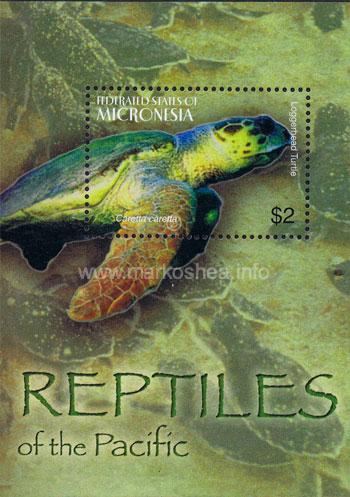 |
$2 Loggerhead turtle
Caretta caretta |
| |
Name on stamp |
Current name |
Accepted common name |
55c |
Maticora bivirgata |
Calliophis bivirgata |
Blue long-glanded coralsnake |
55c |
Ceratobatrachus guentheri |
Ceratobatrachus guentheri |
Emerald tree skink |
55c |
Sphenodon punctatus |
Sphenodon punctatus |
Tuatara |
55c |
Draco volans |
Draco volans |
Common flying lizard |
55c |
Platymantis vitiensis |
Platymantis vitianus |
Fijian treefrog |
55c |
Candoia carinata |
Candoia paulsoni |
Pacific ground boa |
minisheet
|
$2 |
Caretta caretta |
Caretta caretta |
Loggerhead sea turtle |
Where to begin. Well two of the species represented have undergone taxonomic name changes, both snakes, Maticora bivirgata to Calliophis bivirgata and Candoia carinata to Candoia paulsoni, and the common name on the Tuatara stamp is listed as the Levuka wrinkled ground frog, when that is clearly the species underneath - how can anyone confuse a tuatara for a frog!
But there is also the origin of the images that can be questioned. Several of them look familiar, ie. the tuatara and the flying lizard and the coralsnake, but was permission obtained to use these images on the stamp series, produced in the United States for the Federated States of Micronesia. I think not!
The Berne Convention protects copyright for all sorts of things, including unauthorised use of images on postage stamps, and the Federated States of Micronesia became a signatory on 7th October 2003, at least 18months before these stamps were issued, yet they or their US agents chose to ignore copyright and simply use images as they desired.
How do I know this ?
Because the Pacific ground boa (formerly Candoia carinata paulsoni, now C.paulsoni) is my image, scanned from my 1996 book A Guide to the Snakes of Papua New Guinea, without my authorisation or even knowledge. I wrote a letter of complaint and sent it by international recorded delivery to the Postmaster General ofthe Federated States of Micronesia, but their postal service cannot be up to much, because it must have gone missing - I never received a reply. If you would like to learn more about this episode download the article below:
O'Shea M. 2007 A case of copyright theft. The Herptile 32(1):6-9.
Finally, do any of these species occur in the Federated States of Micronesia?
The Blue coralsnake (Calliophis bivirgata) and the Common flying lizard (Draco volans) are Southeast Asian; the Pacific ground boa (Candoia paulsoni) is from New Guinea and the Solomons; the Solomons horned frog (Ceratobatrachus guentheri) is also from the Solomons, the Tuatara (Sphenodon punctatus) is from New Zealand, while the Levuka wrinkled ground frog (Platymantis vitiensis) is from Fiji, although it looks more like the Fijian treefrog (Platymantis vitianus). The only species occuring in the Federated States if Micronesia is the Loggerhead sea turtle (Caretta caretta) on the additional high value minisheet.
So not such an impressive set of stamps.
Associated links on this site:
Micronesian herps on non-herps stamps
|