|
|
||||||||


|
|
1967
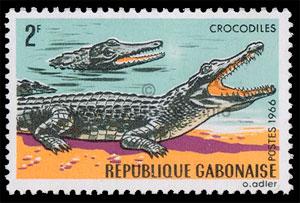
Six stamps featuring the fauna of Gabon, one illustrated with crocodiles which, judging by the narrow-snout of the crocodile in the water, may be intended to represent the rare Narrow-snouted crocodile (Mecistops cataphractus), one of three species of crocodile within Gabon.
1972
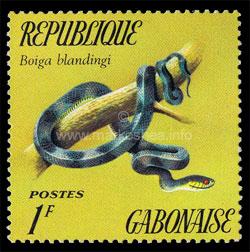
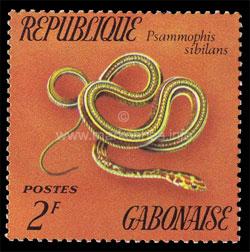
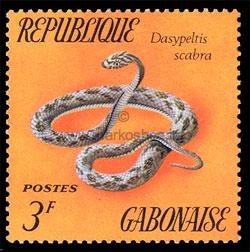
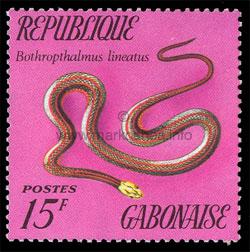
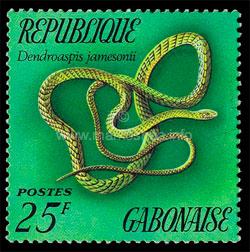
This is a genuinely attractive set of stamps which, although labelled as Reptiles, features all snakes and all from West Africa. The name change for the Blanding's tree snake (Toxicodryas blandingi) is not universally accepted but the sandsnake is certainly not Psammophis sibilans, not with those stripes. The most likely possibility is the Sudan sandsnake (Psammophis sudanensis) but although it is recorded from Cameroon to the north, it may not yet have been found in Gabon. The Common egg-eating snake (Dasypeltis scabra) is acting in an uncharacteristically belligerant manner but the remaining three species seem calm and are well represented, even if the East African gaboon viper (Bitis gabonica) does seem to have horns that are borderline West African gaboon viper (B.rhinoceros). The Red and black striped snake (Bothropthalmus lineatus) and the Jamesons' mamba (Dendroaspis jamesoni) are nice studies even if the head detail leaves a little to be desired. No, a nice set that looks good in an album or a frame on the wall. 1983
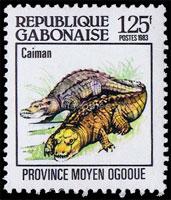
Nine stamps symbolising nine provinces, with the Province of Moyen-Ogooue represented by "Caiman" (Caiman crocodilus) which are actually Central and South American. It might have been that the designer intended these to represent Nile crocodiles (Crocodylus niloticus) but it has to be said they do look much more like caiman than crocodiles. Careless! FAUNA
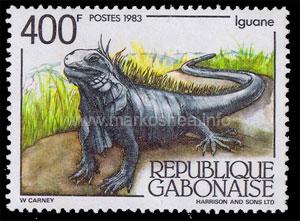
Four examples of 'Gabonaise fauna' with the highest value stamp illustrated by an iguana! From the dewlap and large circular scale on the back of the throat, this is clearly intended to represent a Green iguana, and lacking a horn on the snout it would be the South American green iguana (Iguana iguana iguana), which is oddly, both green and from South America, not grey and from Africa. Yet another example of misleading, lazy stamp production. It is bad enough when these foreign reptiles appear on stamps from the wrong country/continent, but much worse then they are labelled as originating from that country. The only place you could chance to see this lizard in Gabon is Libreville Zoo! Are there no large lizards in Gabon that could have been illustrated instead?
Associated links on this site:
|