PAPUA NEW GUINEA SNAKEBITE PROJECT
THE TEMPTATION OF MARK
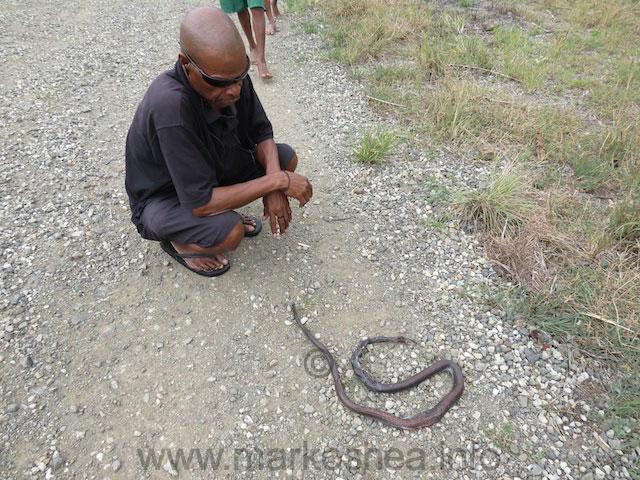
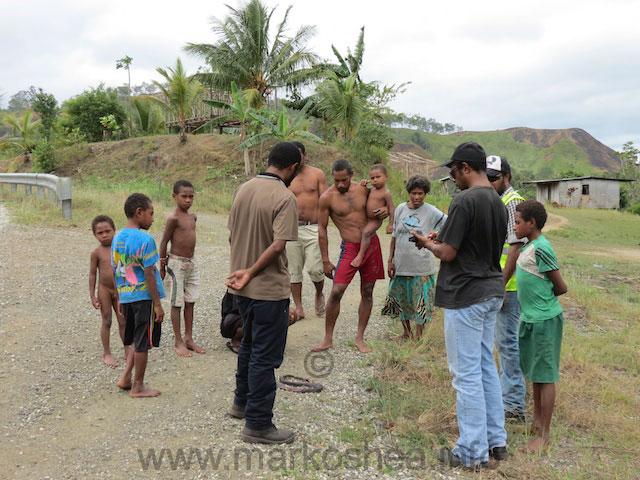
Then just around the best we encountered a third taipan, this time dead on the road, dead of bush knife injuries from a close-encounter with a Papuan villager. As we examined and GPSed the snake people came over to see what we were doing and Owen dropped into education mode, talking about how this species is the one responsible for 90% of the snakebite deaths and serious injuries in PNG, many to people chasing taipan to kill them. Owen handed out some plastic cards showing correct snakebite first aid in Tok Pisin and Motu languages. Dave was keen to get moving on to Kupiano so we dropped the dead taipan in the roadside grass and got back into the vehicles. We move dead snakes off the road, a mark of respect, but also so we don't stop for them on the way back.
 |
 |
| Jasper examines tbe dead taipan |
and when the villagers arrive Owen and the boys slip into educatuonal mode |
We always examine DOR (dead on road) snakes. Note I did not say road-kill because many are not killed on the roads but killed in the bush or gardens and thrown on the roads. The reason for stopping is to confirm identification and recover anything useful for science, the entire carcase if it is not too large or too ripe and we are heading home (a large, smelly dead snake in a hot car on a long journey is not a popular choice). We plot the GPS because a dead snake is a useful record of their presence for distribution even though it may have come from the bush 100 m off to the side and be dumped on the road. Only by examining the cadaver can we tell if it was hit and killed by a vehicle or it died of a clubbed head or bush knife slashes. Even if we are not collecting the specimen as a voucher we may measure it (snout-vent length, total length, note its sex, scale count it) and we often take a live sample for DNA, again if decomposition is not advanced. Finally, for freshly killed venomous snakes we extract the venom glands and place them in a soluton called RNAlater. So what for a herper collecting only live snakes might seen a sad waste, can still provide valuable data for a field herpetologist.
A little further on we came to an area where previously there had been a mass of abandoned metal sheeting, an excellent place to search for snakes as any herper knows. Sadly the sheeting appeared to have been salvaged and apart from a few overgrown pieces all that remained were rows of old oil drums, under which we only found Cane toads (Rhinella marina), Pelagic geckos (Nactus pelagicus) and a few Solomons skinks (Sphenomorphus solomonis). I am not collecting any more vouchers this trip.
 |
 |
| The oil drums |
Another bridge over another 'croc river' |
Click on an image to enlarge it
Click next page below for page 4
|