TIMOR-LESTE REPTILE & AMPHIBIAN SURVEY
LEECHES, LIZARDS AND A SLITHERING SURPRISE
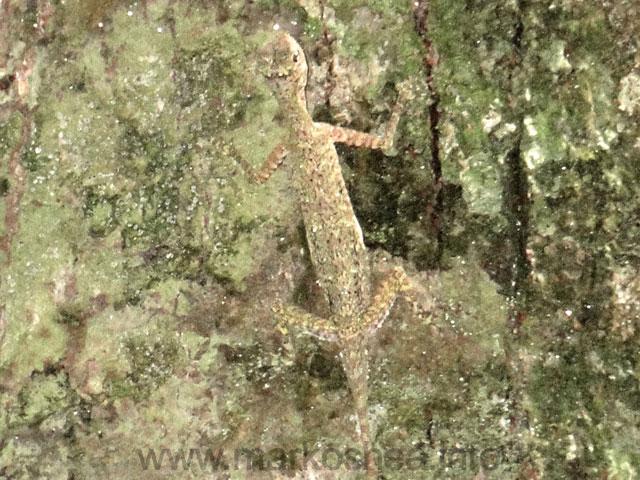
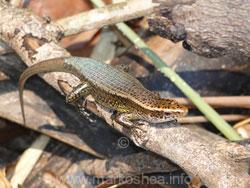
Along the way to the waterfall at the end of the trail, there are some species that have been commonly encountered every time we visited. There are always some Sun skinks (Eutropis multifasciata) in sunspots to either side of the trail, although with sun making itself scarce today the Phase X team encountered most of them only on their way back. They also saw two Black-beared flying lizards (Draco melanopogon) on a large tree next to the trail. Other lizards were seen, but escaped before we were able to photograph them. Sven saw at least three agamid lizards, one most likely the Dusky earless agama (Aphaniotis fusca), seen during our visit in 2013, and the other a larger lizard with a crest right by the river’s edge, most likely a juvenile Great anglehead lizard (Gonocephalus grandis). In addition we saw and pursued a variety of Wedge-headed skinks (Sphenomorphus), but to no avail.
 |
 |
Sun skink, Eutropis cf multifasctiata |
Black-bearded flying lizard, Draco melanopogon |
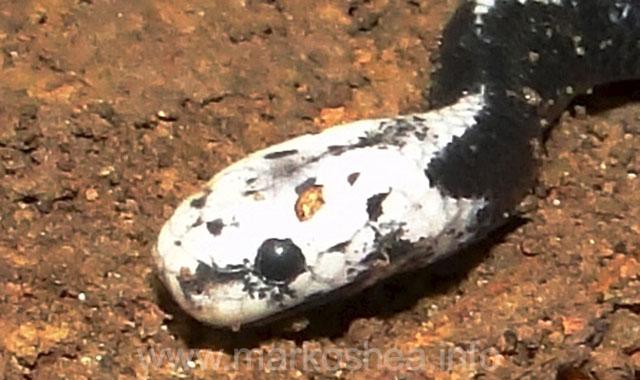
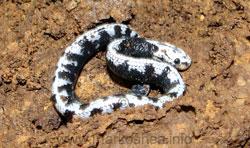
The first slithering surprise was a large brown snake that moved rapidly across the path in front of Sven and headed straight down the bank of the river, glanced up briefly, and then disappeared along the river’s edge. Sven was able to get a good look at the animals and believes it to be a member of the genus Ptyas, a ratsnake. The second surprise was a pretty, little black-and-white snake scarcely longer than a pen that was coiled up under a log. After taking an initial set of photos, Hinrich moved the snake so that they could get a better look at its head, which turned out to have a really short snout. This could mean they were looking at an elapid, and based on its color pattern it would have to be a hatchling of the highly venomous Malayan Krait (Bungarus candidus). However, juvenile kraits already come pretty much with the typical banded pattern of the adult. While it is difficult from the photos to determine whether there is a loreal scale before the eye, there is a very similar snake in the genus of slug-eating snakes (Asthenodipsas malaccanus) with a head coloration that matches the hatchling, although the body coloration is brown in adults. In the absence of any kind of threat display, and given the discrepancy in juvenile color patterns, the concensus is that this was a slug-eating snake hatchling.
 |
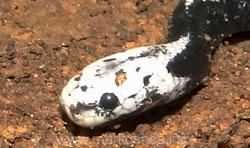 |
Malaccan slug-eater, Asthenodipsas malaccanus,
as it was found |
Is there a scale between the nasal and
the preocular scale?
|
The day ended with visits to two important cultural and religious centers in Kuala Lumpur: the Batu Caves, an important Hindu shrine to honor Lord Murugan, and Thean Hou Temple, an impressive, colorful Buddhist temple. Tomorrow the Phase X team will head to Bali where they will spend a day in a different type of rainforest.
Click on any image to enlarge it
|