|
Capital: N'Djamena
Population: 10,329,200
Languages: French, Arabic
Currency: Central African CFA Franc |
|
|
|
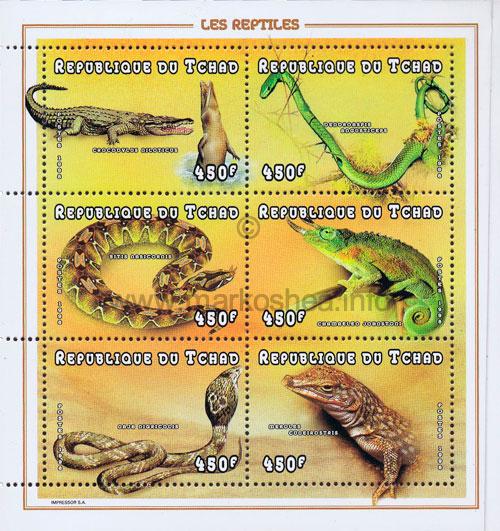
REPTILES
(SG n/a)
|
450f
Crocodylus niloticus |
450f
Dendroaspis angusticeps |
450f
Bitis nasicornis |
450f
Chamaeleo johnstoni |
450f
Naja nigricollis |
450f
Meroles cuneirostris |
| |
Name on stamp |
Current name |
Accepted common name |
450f |
Crocodylus niloticus |
Crocodylus niloticus |
Nile crocodile |
450f |
Dendroaspis angusticeps |
Dendroaspis angusticeps |
East African green mamba |
450f |
Bitis nasicornis |
Bitis nasicornis |
Rhinoceros viper |
450f |
Chamaeleo johnstoni |
Trioceros johnstoni |
Johnston's three-horned chameleon |
450f |
Naja nigricollis |
Naja naja |
Indian cobra |
450f |
Meroles cuneirostris |
Meroles cuneirostris |
Wedge-snouted desert lizard |
At first glance this is a very nice minisheet of reptiles, but are these reptiles Chadian species?
The Wedge-snouted desert lizard (Meroles cuneirostris) is from coastal Namibia, the East African green mamba (Dendroaspis angusticeps) from coastal East Africa, the Rhinoceros viper or River jack (Bitis nasicornis) occurs in West and Central Africa, while Johnston's three-horned chameleon (Triocornis johnstoni) is Central African.
Of the snakes and lizards named on the stamps, only the Black-necked spitting cobra (Naja nigricollis) enters southern Chad, but unfortunately the cobra illustrated is not that species, it is clearly a Spectacled Indian cobra (Naja naja) and does not even occur in Africa.
There were two recent crocodile populations, one extant in the Ennardi Mts in the east and an extinct population in the Tibesti Mts in the north (see map). It is likely these are Nile crocodiles (Crocodylus niloticus) rather than the West African crocodile (C.suchus) of further west. So potentially two from six stamps represent Chadian species.
Associated links on this site:
Chad herps on non-herps stamps
|