|
|
||||||||


|
PAPUA NEW GUINEA 2013
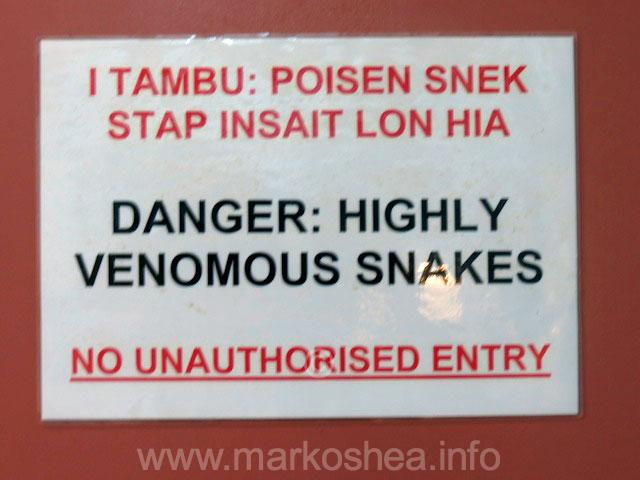
National Capital District Charles H. Campbell was to Papua what Struan Sutherland (1936-2002) was to Australia. If Sutherland was the leading-light in snakebite treatment and antivenom production at the Commonwealth Serum Laboratories (CSL) in Melbourne from the 1960s, then Campbell was the pioneer of snakebite treatment in Papua. During the 1960s he was based at PMGH and he completed his doctorate thesis "A Clinical Study of Venomous Snake Bite in Papua" in 1969. The new Charles Campbell Toxinology Centre is named in his honour. The first thing Dave wanted to show me was how things had changed since I was last in PNG three years previously, not just the new roads and buildings, but the snakebite project, which had received some well needed funding (although still below budget requirements). We began a tour of the facilities, starting at the Snek Haus, the herpetarium where we keep the highly venomous snakes being milked for venom research and antivenom production. Charles Campbell Herpetarium
aka Snek Haus The current stock included nine Papuan taipan (Oxyuranus scutellatus canni), two Papuan blacksnakes (Pseudechis papuanus), two New Guinea small-eyed snakes (Micropechis ikaheka), nine Smooth-scaled death adders (Acanthophis laevis), two Black whipsnakes (Demansia vestigiata), and a few nonvenomous snakes which had been used educational purposes but which were due for release.
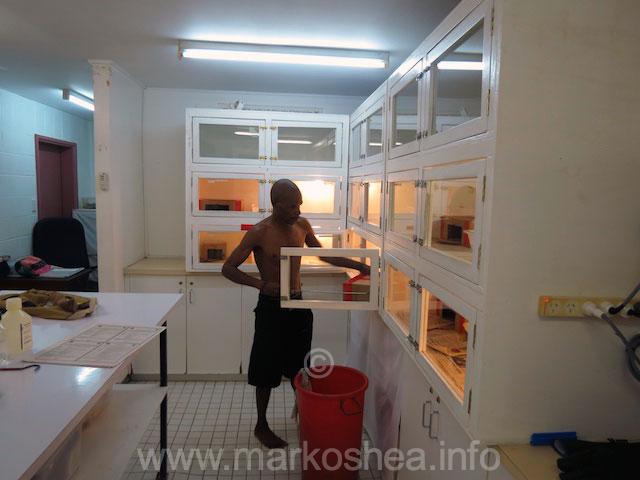
I spent a lot of time in the Snek Haus with snake room technician Jasper Gabugabu and researcher Owen Paiva. This is where all the snakes are maintained, where veterinary proceedures are undertaken, where venom is extracted, where DNA samples are extracted, snakes are documented, scale-counted and photographed.
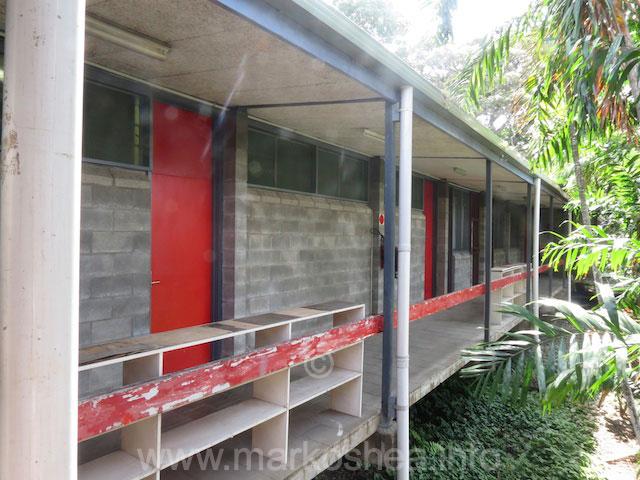
The Charles Campbell Toxinology Centre is a state-of-the-art facility located on an unassuming corridor in the University of PNG Faculty of Medicine, a few metres from the Snek Haus. It is planned that soon this unit will organise the distribution of all antivenoms within PNG, making sure the clinics and health care centres receive the antivenoms most applicable to the medically important snakes in their region.
Charles Campbell Toxinology Centre Clinical Trial Office The Charles Campbell Clinic is attached to the Intensive Care Unit (ICU) in Port Moresby General Hospital, a few minutes walk from the laboratory. In this unit snakebite patients are assessed and treated, some 80 in the previous two months without a single fatality. A remarkable achievement considering most of the bites are caused by the Papuan taipan.
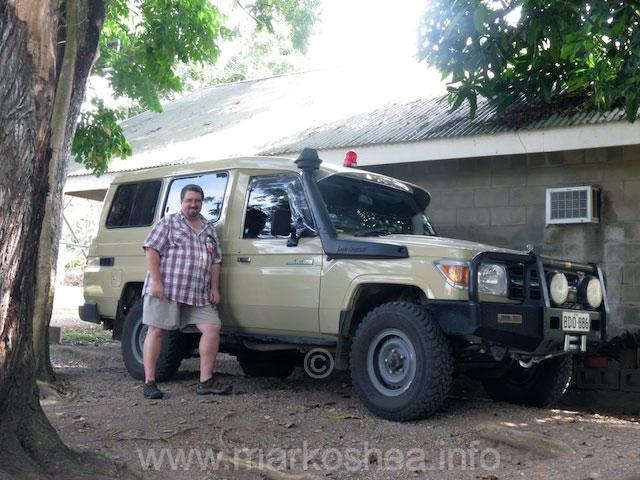
Charles Campbell Toxinology Centre Ambulance Dave was the proud posessor of a newly equipped, all-terrain Toyota Troop Carrier (Troopie) Snakebite Ambulance which he used to collect victims from villages near to Port Moresby or to meet incoming ambulances from rural health care centres.
|
|||||||||||||||||||||||||||||||||||