Capital: Kinshasa
Population: 70,916,400
Languages: French
Currency: Congolese Franc |
|
|
|
REPTILES
(SG 1273-1278)
 |
 |
 |
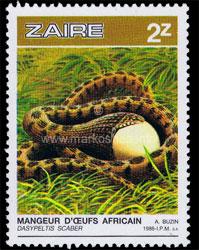
2z Mangeur d'oeufs Africain
Dasypeltis scaber |
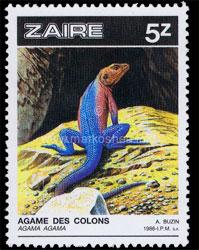
5z Agame des colons
Agama agama |
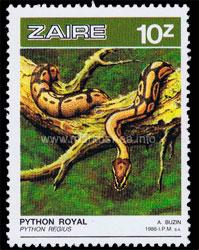
10z Python royal
Python regius |
|
|
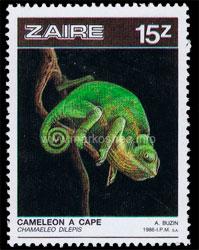
15z Cameleon a Cape
Chamaeleo dilepis |
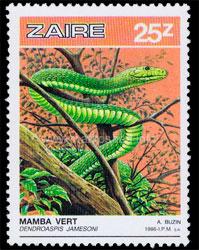
25z Mamba vert
Dendroaspis jamesoni |
|
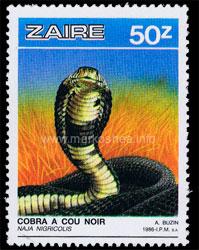
50z Cobra a cou noir
Naja nigricollis |
| |
Name on stamp |
Current name |
Accepted common name |
2z |
Dasypeltis scaber |
Dasypeltis scabra |
Common egg-eating snake |
5z |
Agama agama |
Agama agama |
Common agama (male) |
10z |
Python regius |
Python regius |
Royal or Ball python |
15z |
Chamaeleo dilepis |
Chamaeleo dilepis |
Flap-necked chameleon |
25z |
Dendroaspis jamesoni |
Dendroaspis jamesoni |
Jameson's mamba |
50z |
Naja nigricollis |
Naja nigricollis |
Black-necked spitting cobra |
A very smart set of stamps featuring two lizards and four snakes, all of which occur within the borders of the Democratic Republic of Congo, and curiously only one slight name change since 1987, the the Common egg-eating snake (Dasypeltis scabra).
series featur
SNAKES
(SG n/a)
|
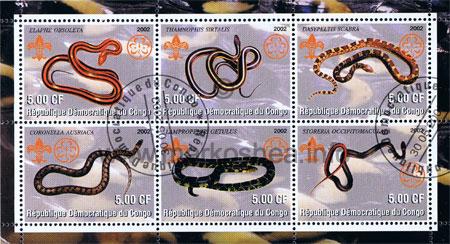
5cf Elaphe obsoleta |
5cf Thamnophis sirtalis |
5cf Dasypeltis scabra |
5cf Coronella austriaca |
5cf Lampropeltis getulus |
5cf Storeria occipitomaculata |
| |
Name on stamp |
Current name |
Accepted common name |
5cf |
Elaphe obsoleta |
Pantherophis alleghaniensis |
Eastern ratsnake |
5cf |
Thamnophis sirtalis |
Thamnophis sirtalis |
Eastern gartersnake |
5cf |
Dasypeltis scabra |
Dasypeltis scabra |
Common egg-eating snake |
5cf |
Coronella austriaca |
Coronella austriaca |
Smooth snake |
5cf |
Lampropeltis getulus |
Lampropeltis getula |
Common kingsnake |
5cf |
Storeria occipitomaculata |
Storeria occipitomaculata |
Redbelly snake |
After the Zaire snake stamp this is a step backwards into lazy stamp design. The common egg-eating snake (Dasypeltis scabra) appears again, a Congolese species and this time with the correct suffix to its name, but something tells me that was just luck because the other five snakes are about as African as a polar bear. The ratsnake (Pantherophis alleghaniensis), gartersnake (Thamnophis sirtalis), kingsnake (Lampropeltis getula) and Redbelly snake (Storeria occipitomaculata) are from the USA while the Smooth snake (Coronella austriaca) is western European and would achieve a great deal more on a British stamp, being our rarest and most protected reptile. These stamps, with their obligatory Boy Scout fleur-de-lis and Guide Guide shamrock, are obviously produced by the same company that prepared similar stamps for Benin and pre-Independance Timor. And unfortunately, Congo-Kinshasa issued even more poor stamps in 2004.
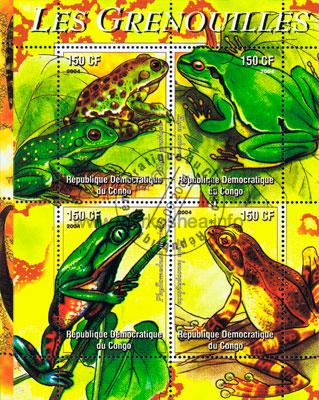
TREEFROGS
(SG n/a)
|
150cf Hyla gratiosa |
150cf Hyla arborea |
150cf Phyllomedusa iheringi |
150cf Hyla leucophylata |
| |
Name on stamp |
Current name |
Accepted common name |
150cf |
Hyla gratiosa |
Hyla gratiosa |
Florida treefrog |
150cf |
Hyla arborea |
Hyla arborea |
European green treefrog |
150cf |
Phyllomedusa iheringi |
Phyllomedusa iheringi |
Southern walking leaf-frog |
150cf |
Hyla leucophylata |
Dendropsohus leucophyllatus |
White leaf-frog |
Four treefrogs, one from Europe, one from N.America and two from S.America, and the Congo is the largest area of tropical rainforest in Africa - need I say more!
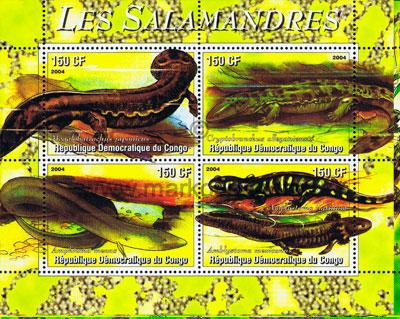
SALAMANDERS
(SG n/a)
|
150cf Megalobatrachus japonicus |
150cf Cryptobranchus alleganiensis |
150cf Amphiuma means |
150cf Amblystoma mexicanus |
| |
Name on stamp |
Current name |
Accepted common name |
150cf |
Megalobatrachus japonicus |
Andrias japonicus |
Japanese giant salamander |
150cf |
Cryptobranchus alleganiensis |
Cryptobranchus alleganiensis |
Hellbender |
150cf |
Amphiuma means |
Amphiuma means |
Two-toed amphiuma |
150cf |
Amblystoma mexicanus |
Amblystoma mexicanus |
Tiger salamander |
Salamanders are an unusual topic for stamps (outside of Yugoslavia) and it has to be admitted, they do not venture into Africa so these are bound to be no Congolese species, although stretching a point, an alternative name for the North American Two-toed amphiuma (Amphiuma means) is "Congo-eel". The other species here represented at N.American hellbender (Cryptobranchus alleganiensis), the related Japanese giant salamander (Andrias japonicus) and both adult and neonates phase of the Mexican Tiger salamander (Amblystoma mexicanus), the immature stage being the famous Axolotl. I think this is the one stamp sheet in this run of sheets I can excuse due to the unusual subject matter and its lack of African representatives.
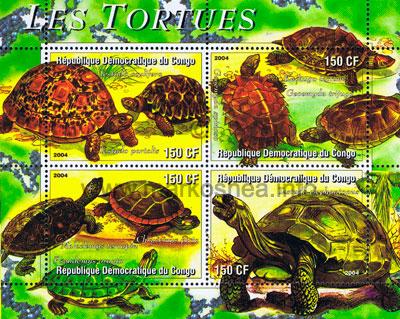
TURTLES
(SG n/a)
|
150cf Testudo oculifera
Testudo partalis
|
150cf Kachuga tectum
Geoemyda trijuga
Geoemyda spinosa |
150cf Chrysemys picta
Malaclemys terrapin
Pseudemys ornata
|
150cf Testudo elephantopus |
| |
Name on stamp |
Current name |
Accepted common name |
150cf |
Testudo oculifera |
Psammobates oculifera |
Serrated tortoise |
Testudo partalis |
Stigmochelys pardalis |
Leopard tortoise |
150cf |
Kachuga tectum |
Batagur tecta |
Indian roofed turtle |
Geoemyda trijuga |
Melanochelys trijuga |
Indian black turtle |
Geoemyda spinosa |
Heosemys spinosa |
Spiny turtle |
150cf |
Chrysemys picta |
Chrysemys picta |
Painted turtle |
Malaclemys terrapin |
Malaclemys terrapin |
Diamondback terrapin |
Pseudemys ornata |
Trachyemys ornata |
Ornate slider |
150cf |
Testudo elephantopus |
Chelonoides nigra |
Galapagos giant tortoise |
Nine turtles and tortoises on one sheet of four stamps, a bit crowded. And of those only two had the correct scientific names. As for distribution, there are two African species there, but neither occurs in Congo, three Asian species, three American and one from the Galapagos Islands. Disappointing.
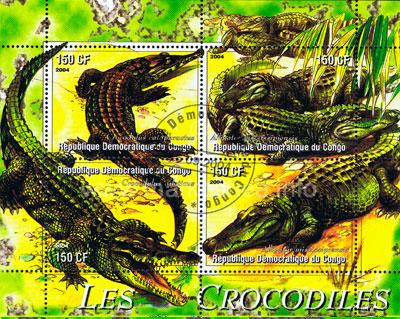
CROCODILIANS
(SG n/a)
|
150cf Crocodylus cataphractus
|
150cf Alligator mississippiensis |
150cf Crocodylus niloticus
|
150cf Alligator mississippiensis |
| |
Name on stamp |
Current name |
Accepted common name |
150cf |
Crocodylus cataphractus |
Mecistops cataphractus |
Narrow-snouted crocodile |
150cf |
Alligator mississippiensis |
Alligator mississippiensis |
American alligator |
150cf |
Crocodylus niloticus |
Crocodylus niloticus |
Nile crocodile |
150cf |
Alligator mississippiensis |
Alligator mississippiensis |
American alligator |
Two stamps with the American alligator (Alligator mississippiensis), wonder what happened there. The other two are crocodiles that do occur in Congo, the narrow-snouted crocodile (Mecistops cataphractus) and the ubiquitous Nile crocodile (Crocodylus niloticus).
MONITOR LIZARDS
(SG n/a)
|
150cf Varanus salvator
|
150cf Varanus albigularis
Varanus griseus |
|
150cf Varanus komodoensis |
| |
Name on stamp |
Current name |
Accepted common name |
150cf |
Varanus salvator |
Varanus salvator |
Water monitor |
150cf |
Varanus albigularis |
Varanus albigularis |
White-throated monitor |
Varanus griseus |
Varanus griseus |
Desert monitor |
150cf |
Varanus niloticus |
Varanus niloticus |
Nile monitor |
150cf |
Varanus komodoensis |
Varanus komodoensis |
Komodo dragon |
Five monitor lizards on four stamps, including the wide-ranging tropical African Nile monitor (Varanus niloticus). Also included is a N.African-Arabian species, a southern African species, a wide-spread Asian species and the Komodo dragon (Varanus komodoensis) from Indonesia.
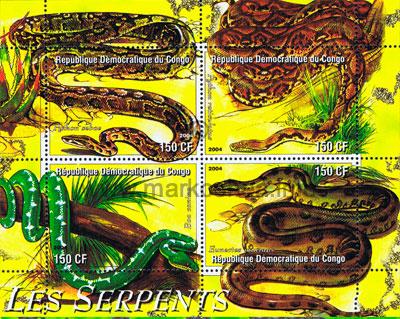
CONSTRICTORS
(SG n/a)
|
150cf Python sebae
|
150cf Python reticulatus |
|
150cf Eunectes murinus |
| |
Name on stamp |
Current name |
Accepted common name |
150cf |
Python sebae |
Python sebae |
Central African rock python |
150cf |
Python reticulatus |
Broghammerus reticulatus |
Reticulated python |
150cf |
Boa canina |
Corallus caninus |
Emerald tree boa |
150cf |
Eunectes murinus |
Eunectes murinus |
Green anaconda |
Another African species, the African rock python (Python sebae), one Asian and two South American, but the Emerald tree boa (Corallus caninus) is actually a relatively small species, there could have been several other large species to include with the other giants.
Associated links on this site:
Congo-Kinshasa herps on non-herps stamps
Congo-Kinshasa first day covers
|