|
|
||||||||


|
O'SHEA SHOP: O'SHEA POSTCARDS
O'Shea Postcards
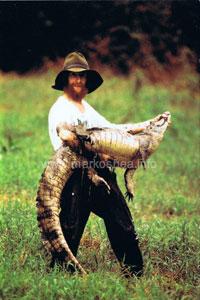
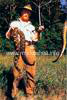
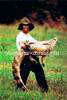
During the 1980s and 1990s, long before he appeared on television, Mark built up a large and successful UK lecture circuit, travelling England and Wales to deliver talks on reptiles, illustrated with slides and live specimens, to Rotary and Round Table, schools, natural history societies, herpetological societies, scouts, universities, colleges and other groups. At the end of the talk Mark was often asked for his autograph so he decided to produce a postcard for this purpose. The image chosen (below) was of a large Central American green iguana (Iguana iguana rhinolopha) he had captured in a remote region of northeastern Honduras during Operation Raleigh's Black River Expedition in 1985. In 1989, at the 1st World Congress of Herpetology in Cnterbury, Kent, UK, Mark gave one of these iguana postcards to the highly respected herpetologist couple Sherman A. Minton and Madge R.Minton. Sherman A.Minton, who served with the US Navy in the Pacific Theatre of World War II, became one of the most respected snake venom toxinologists and herpetologists of his generation, while Madge R.Minton was a WASP (Woman Airforce Service Pilot) who deliver fighter aircraft for the USAF and later supported her husband in his herpetological research and book writing (Venomous Reptiles - 1969, and Giant Reptiles - 1973). Sherman passed away in 1999 and Madge followed in 2004. Whilst sorting through Madge's effects her daughters found the postcard and contacted me, asking me to sign it for them.
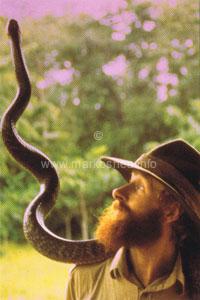
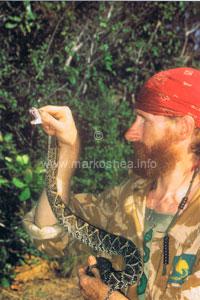
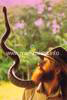
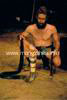
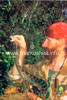
The initial print run of 1,000 postcards ran out by 1989 and the card was reprinted along with three other postcards featuring a Yellow tailed cribo (Drymarchon corais corais) and a pair of Roraima rattlesnakes (Crotalus durissus ruruima) captured durign the RGS Maracá Rainforest Project, in Brazil, and a Forest cobra (Naja melanoleuca) captured on the Operation Raleigh Cameroon Expedition, in 1989. At a second print run the original rattlesnake postcard image (OPC003), which showed Mark free-handling the two rattlesnakes, was replaced with one showing him using safer snake-hooks (OPC003a). It was felt the original image might be seen as gung-ho (not Mark's approach to venomous reptiles at all) and it might encourage youngsters to pick up venomous snakes by the tail, with serious consequences.
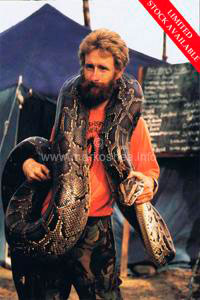
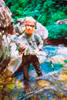
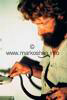
This first series of four postcards was followed in 1992 by a second series of four postcards featuring a Burmese rock python (Python bivittatus) and Indian cobra (Naja naja) captured on the second Karnali Quest expedition to Nepal, in 1992, and a Boelen's python (Morelia boeleni) and Papuan taipan (Oxyuranus scutellatus canni) from Papua New Guinea in 1990, working on the BBC Natural World New Guinea: An Island Apart, and Oxford University's PNG Snakebite Project.
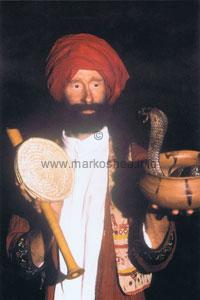
In 1998 a final set of postcards was produced, featuring a Rupununi rattlesnake (Crotalus durissus trigonicus) from the Land of Eldorado expedition to Guyana in 1993, a snake-charmer with his Egyptian cobra (Naja haje) during filming of the Ultimate Guide to Snakes, for Discovery Channel, and a Spectacled caiman (Caiman crocodilus crocodilus) captured in 1997, during filming of Giant Snake in Venezuela, also for Discovery Channel.
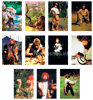
O'Shea Postcards available for sale: Postcards are collectable, frameable, or useable. Sending notes on postcards through the post, either open postcard or enclosed in an envelope, is a very nostalgic and personal way to communicate. For this reason these postcards were produced with an address side on the right, a small area for a scribbled note on the left, and a place for a stamp or stamps in the top-right. The complete set of O'Shea Postcards from 1985-1997 includes eleven different postcards. Individual postcards are also available but two of the eleven (OPC005 & OPC006) were very popular and are therefore only now available as part of the complete set. The remaining nine postcards are available for single or multiple purchase.
See also Pythons of Papua New Guinea mini-set
|
||||||||||||||||||||||||||||||||||||||||||||||||||||||||||