|
|
||||||||


|
SOUTH AFRICA 2005
Cape Reptile Institute
Goegap Nature Reserve
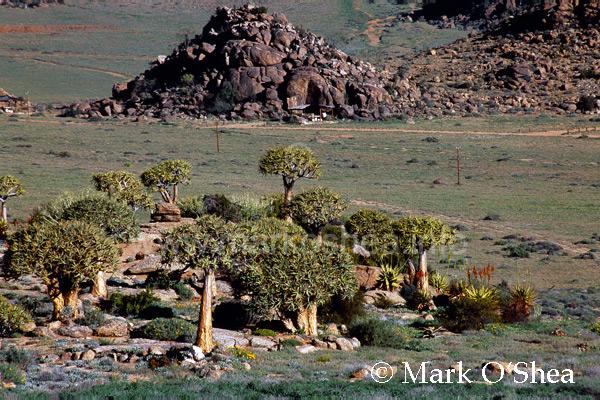
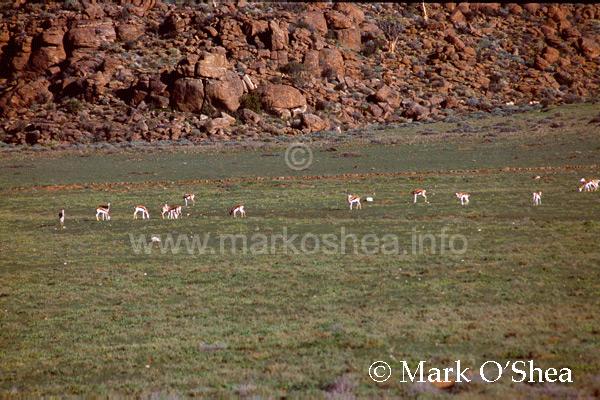
Goegap Nature Reserve is a small (16,000 hectare) reserve 15kms east of Springbok. Goegap means 'water hole'. The reserve is popular for its antelope and zebras, its birds, and its unique flora ranging from Quiver trees (aka Kokerboom, Aloa dichotoma) the branches of which were formerly used by the indigenous San for arrow quivers, to a wide variety of desert-floor succulents. The Hester Malan Wild Flower Garden is located within Goegap, as also apparently are 600 species of plants.
Although they are not as obvious as a quiver tree, an oryx or an ostrich, Goegap is also home to an interesting array or reptiles and amphibians.
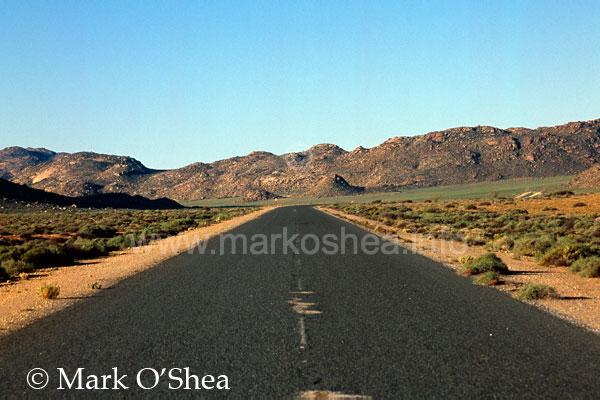
The habitat consists of flat open valleys between small rocky hills.
We concentrated our searches on the rock hills. This being a nature reserve, we were very conscious of the maxim: Take nothing but photographs, leave nothing but footprints. In fact we tried not even to leave those and any rocks turned to look for secretive species were carefully replaced exactly as we found them. We used heliographs to peer into crevices for rock-dwelling lizards.
As would be expected in a rocky environment, geckos were much in evidence, once one looked for them. We found large, robust Bibron's thick-toed geckos (Chondrodactylus bibroni) and small, gracile Weber's thick-toed geckos (Pachydactylus weberi) and two species of the souhern African endemic leaf-toed gecko genus Goggia: the Striped dwarf leaf-toed gecko (Goggia lineata) and Namaqualand dwarf leaf-toed gecko (G.rupicola).
The Karoo girdled lizard (Cordylus polyzonus) would not permt close approach and the Plated lizards (Gerrhosaurus sp.) remained hidden and refused to even be identified to species.
I have a particular fascination for fossorial herps and two species made my visit to Goegap well worth while. Boulenger's blind legless skink (Typhlosaurus vermis) is an elongate pink burrower I was truely excited to photograph.
Delalande's beaked blindsnake (Rhinotyphlops lalandei) was an additional bonus, both being species rarely encountered unless one looks hard for burrowing species.
The dangerous Granulated fat-tail scorpion (Parabuthus granulatus) and the Namaqualand giant centipede (Cormocephalus cf. multispinosus) were also found in the reserve.
|
||||||||||||||||||||||||||||||||||||||||||||||||||||||||||||||||||||||||