|
|
||||||||


|
TIMOR-LESTE 2011
Victor Valley College Tropical Research Initiative Comoro River, Dili District
While Hinrich was occupied with administrative matters, the rest of the Americans plus Zito and Mark drove up the Comoro River, which is mostly a dry river bed with a narrow river at this time of year, past dozens of men back-breakingly mining river sand for construction, until we reached the same village where we collected in 2010. Here we split into two groups. Robert took the first group, with Caitlin and Zito as experienced hands, and Paul and Joanna as novices, up the slopes into the banana plantations. Mark took the second group, with Scott back for his third phase, and newbies Kyle and David, out onto the open, coarsely vegetated river valley. Both groups where accompanied by willing children from the village who were keen to find reptiles, amphibians and invertebrates.
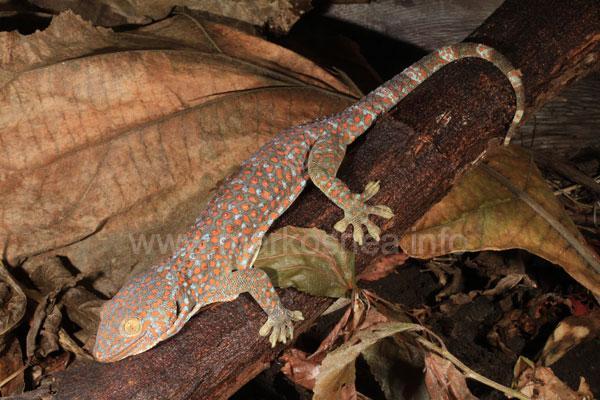
We searched around the villages, rice paddies and flood-water barriers but only located Tokay geckos (Gekko gecko), Common house geckos (Hemidactylus frenatus) and the Asian black-spined toad (Duttaphrynus melanostictus), also known as the Interfet toad because it was probably introduced with INTERFET peace-keeping troops from Asia in the early years after the Indonesian invasion*. Both were very common, Scott and Mark finding five together, and a pair of eggs, in the roof of one small chicken shack. The other team found tokays and Striped treefrogs (Polypedates cf. leucomystax) in the banana plants but could not capture the treefrogs. This was not a problem since we already had specimens from the Comoro River from our Phase III visit. The idea of the excursion was as an introduction into herping in Timor-Leste rather than a collecting trip. * The idea that this toad was introduced by Australian troops results from a confusion. The Asian black-spined toad now found in Timor-Leste is a completely different species with a completely different origin from the Cane toad (Rhinella marina), deliebrately introduced into Australia from South America as a sugar-cane crop-pest control in the 1930s.
|
||||||||||||||||||