|
|
||||||||


|
GREECE 2012
Greek Photo-Herp Trip
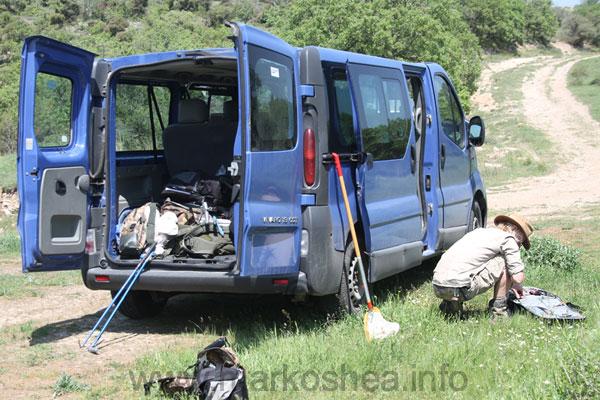
Loutrós, Thrace Province Loutrós is a small agricultural town in eastern Thrace which served as a useful hub for exploratory herp trips into the hills to the north, west and east and down to the riverine floodplains in the south. We explored a variety of habitat types from densely wooded hillsides and rocky outcrops and hill-tops to marshlands, pools, ponds and dams. We covered a lot of ground... you have to if you want to find as diverse a selection of reptiles and amphibians as we set out to photograph.
We were literally spoiled for choice when it came to where to search for reptiles around Loutrós. We started out on the hill tops and gradually worked our way down into the valleys.
The bare rocks and scrubby vegetation on the hill tops provided suitable habitat for Eastern spur-thighed tortoise (Testudo graeca ibera), Thracian scheltopusik (Pseudopus apodus thracius) and Balkan green lizards (Lacerta trilineata trilineata) and many different snakes, including European blindsnakes (Typhlops vermicularis), Caspian whipsnakes (Dolichophis caspius), European catsnakes (Telescopus fallax fallax) and Ottoman vipers (Montivipera xanthina).
Amongst the invertebrates found on the rocky, wooded hillsides were a Brown bush cricket (Isophya or Poecilimon sp.) and a very alien, Cone-head mantis (Empusa fasciata).
Our first Ottoman viper came from a location to the north of Loutrós, on a rocky-hillside near the river. Dave and I were together when it crossed our path and he just got his tongs to it as it poured itself into a crevice under a rock, it was a remarkable and lucky capture. We bagged the snake, GPSed the exact spot and came back down to the others, victorious. After extensive photography the snake was returned to the exact rock under which it was heading when captured.
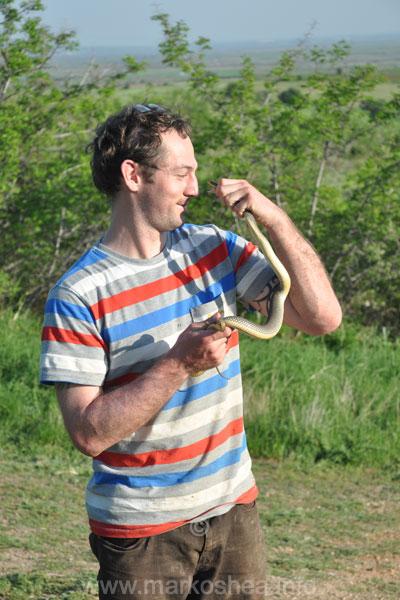
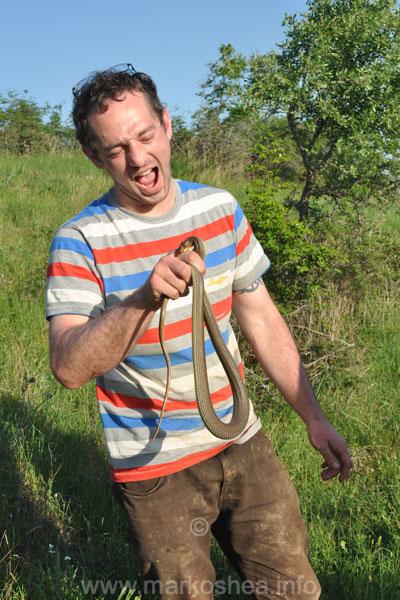
One of the commonest snakes encountered was the Caspian whipsnake (Dolichophis caspius), in the 4.5 days we saw at least 13 identifiable whipsnakes and managed to capture three.
The photograph on the right shows Axel Barlow confidently demonstrating the calm method of handling one of these flighty and bitey snakes without incident, followed a a sequence of photographs where Dave Nixon demonstrates a different method of whipsnake handling.
A dammed stream high in the hills provided a suitable habitat for amphibians. Here we found numerous Common marsh frogs (Pelophylax ridibundus), as well as a European treefrog (Hyla arborea) and a newly metamorphosed Common smooth newt (Lissotriton vulgaris vulgaris). We wondered about Balkan grass snakes (Natrix natrix persa) but did not find any.
Near the pond we also found several extremely busy Dung beetles (Scarabaeus sp.) rolling huge balls of dung to their burrows as food, and a large female Wolf spider (Lycosa singoriensis) in her burrow, guarding her cocoon. We also found a large False widow spider (Steatoda sp.) which closely remembles the highly venomous Black widow spider (Latrodectus mactans). All were too good to pass up without photography sessions.
|
||||||||||||||||||||||||||||||||||||||||||||||||||