Thirteen species of lizards were recorded from Ongava Game Reserve during the 1997 survey. They belong to the six families: Agamidae (agamas and dragons), Chamaelonidae (chameleons), Gekkonidae (true geckos), Lacertidae (Old world lizards), Scincidae (skinks) and Varanidae (monitor lizards). Two additional species were recorded after the initial survey ended and these are contained in a separate section.
Agamidae:
Agama aculeata aculeata - Ground agama These small agamas were found across the reserve in sandy, low scrubby habitats where they retreated to thorny bushes of holes when approached. Nooses proved effective in capturing specimens.
Ground agama, Agama aculeata aculeata
Chamaeleonidae:
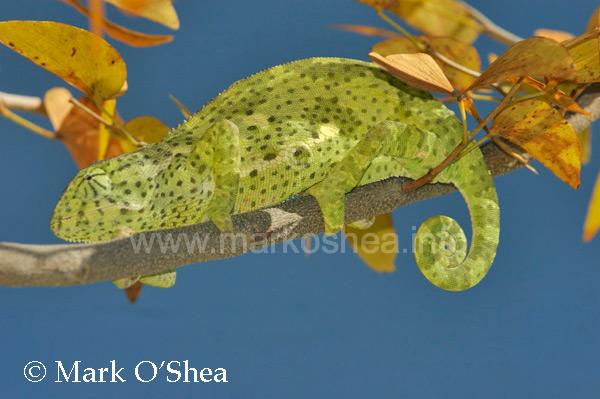
Chamaeleo dilepis - Flap-necked chameleon
A large chameleon with adornements limited to scaly flaps at the rear of the head, the flap-necked chameleon was found to be remarkably common in the mopane trees on the reserve but they were also encountered crossing roads. Nine specimens were captured the survey, of both sexes and all age classes.
Flap-necked chameleon, Chamaeleo dilepis
Gekkonidae:
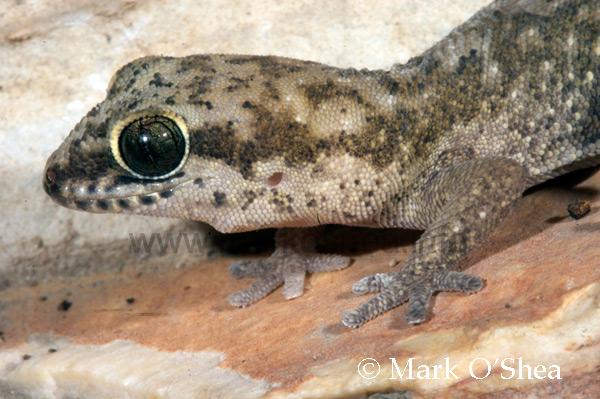
Chondrodactylus turneri turneri - Turner's thick-toed gecko
The largest and commonest gecko encountered, hunting insects in virtually every building on the reserve, in rock piles and under any cover large enough to afford shelter.
Turner's thick-toed gecko, Chondrodactylus turneri turneri (specimen with complete tail)
Turner's thick-toed gecko, Chondrodactylus turneri turneri (specimen with regenerated tail)
Lygodactylus bradfieldi - Bradfield's dwarf gecko
A single specimen of this small arboreal gecko was found in rubble near Margo House (location K).
Bradfield's dwarf gecko, Lygodactylus bradfieldi
Pachydactylus punctatus - Spotted thick-toed gecko
A single specimen of this petite gecko was collected under a large rock at the capture boma (location C). Two clutches of eggs were also obtained under the same rock, incubated until the clutch hatched, where-upon the hatchling geckos were identified as P.punctatus and released back at the same location as the adult. The other clutch did not hatch.
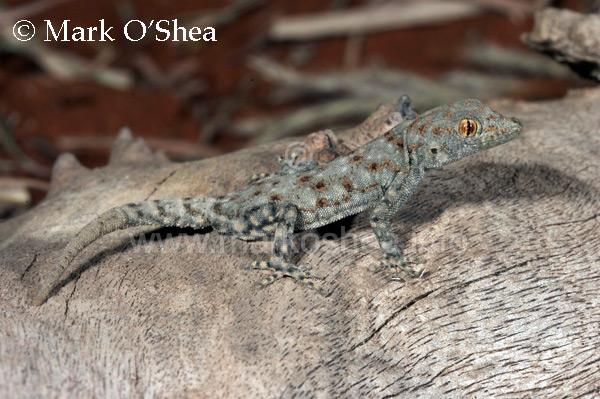
Rhoptropus boultoni - Boulton's Namib day gecko
Two specimens of this rock dwelling gecko was collected as Margo House (location K) and Rainer's Pos (location N).
Boulton's Namib day gecko, Rhoptropus boultoni
Lacertidae:
Heliobolus lugubris - Bushveld lizard
This curious lizard, which adopts a hunch-backed running posture that is beleived to mimic a poisonous beetle, was only recorded from a single juvenile specimen, on a sandy bank outside ORC (location L).
Bushveld lizard, Heliobolus lugubris
Scincidae:
Mochlus sundevallii sundevallii - Sundevall's writhing skink
The only truly fossorial reptile found during the survey, and the sole member of its genus in Namibia, the writing skink was found in both drift fences (locations E and F) and under rocks around the reserve at Margo House, Tiervlei, Ongava Tented Camp and Sonop Old Reservoir (locations K, L, M and P).
Trachylepis binotata - Ovambo tree skink
The largest skink encountered, the Ovambo tree skink was difficult to capture without nooseing. A highly alert and arboreal lizard, it could not be approached closely. We found individual specimens on large trees only and even then only one skink per tree or group of close trees, suggesting some territoriality. Four specimens were captured, two each at Mopane Dam (location J) and Ongava Tented Camp (location M), although others evaded capture.
Ovambo tree skink, Trachylepis binotata
Trachylepis spilogaster - Kalahari tree skink
A smaller tree skink, the Kalahari tree skink appeared to be confined to trees smaller than those inhabited by the Ovambo tree skink, and it also was found in numbers, several skinks on the same tree. This was the most frequently encountered skink in the reserve, found in most locations, and six specimens were captured during the survey.
Kalahari tree skink, Trachylepis spilogaster
Ovambo tree skink, Trachylepis binotata seems to prefer large trees.
Kalahari tree skink, Trachylepis spilogaster seems to prefer small trees.
Trachylepis sulcata sulcata - Western rock skink
The Western rock skink was found in rock piles around old human habitations. The species is sexually dichromatic and dimorphic, females being smaller than males, and striped. Tree specimens were captured at Leeupoort House, Ongava Lodge and Margo House (locations H, I and K respectively).
Western rock skink, Trachylepis sulcata sulcata (l=male; r = female)
Trachylepis punctulata - Eastern variegated skik
A small skink from sandy and rocky habitats, we found only four specimens, near man-made structures ie. Leeuport House, Ongava Lodge and Margo House (locations H, I and K respectively) and in a bush at Mopane Dam (location J).
Eastern variegated skink, Trachylepis punctulata
Varanidae:
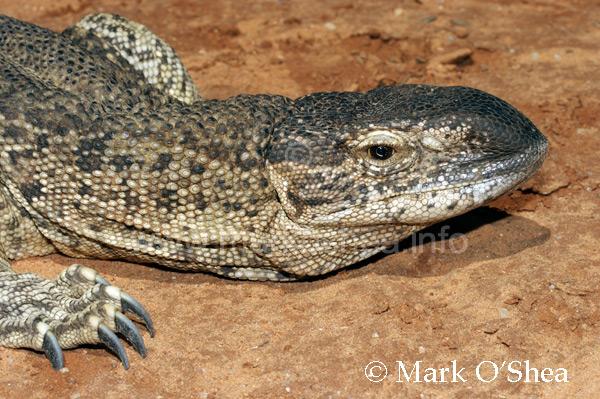
Varanus albigularis - White-throated monitor lizard
A single adult monitor lizard was captured on the sandy road leading to the red sand drift fence (location F). Extremely defensive when cornered, the lizard was easily captured using M1 tongs. Being the largest lizard encountered during the survey, and being too large and destructive to maintain at ORC until the film crew arrived, it was transferred to the dam at Margo House (location K), from where it escaped by climbing out.