|
|
||||||||


|
TIMOR-LESTE 2010
Victor Valley College Tropical Research Initiative Dili to Oecusse District
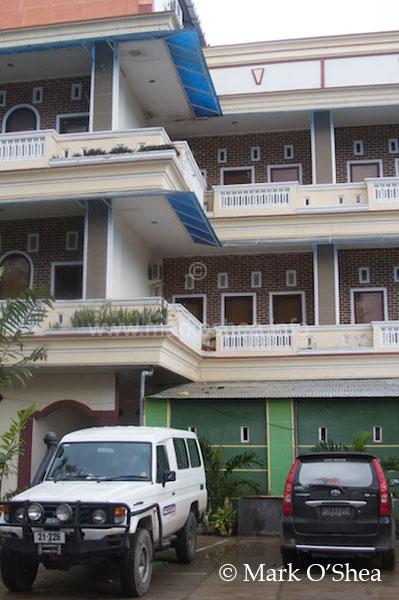
Oecusse, or Oecussi-Ambeno*, is an exclave of Timor-Leste (East Timor) within West Timor (Indonesia). Timor-Leste, including Atauro and Jaco Islands and Oecusse, were Portuguese colonies, while West Timor was part of the Dutch East Indies, which became modern day Indonesia. * There is some confusion over the correct spelling of Oecussi or Oecusse and there are other variations. There are three ways to reach Oecusse from Dili: by road, by ferry, or by UN helicopter. We considered all three routes and settled on driving there with our two Toyota Troop Carriers, a journey reckoned to take six hours but which actually took considerably longer. Two of our expedition members (Christy and Luis) travelled to, and returned from Oecusse by ferry, for logistical reasons.
The journey from Dili to the border takes about 3hrs, depending on the number of stops, and passes through the coastal habitats of western Dili District, Liquiça and Bobonaro Districts. We had previously driven this road to beyond Maubara earlier in the year so that stretch was familiar territory.
The border crossing also took some time, with two vehicles, five American passports, one British passport and two East Timorese passports. By the time we were driving through Atambua in West Timor it became obvious we could not make the border crossing into Oecusse before it closed at 17:00* so we took our feet of the gas and drove at a more leisurely speed, the plan now being to overnight in Kefamenanu and cross the border when it opened at 09:00. * East Timor (including Oecusse) is one hour ahead of Indonesia (including West Timor) so 17:00 on the Timor-Leste side of the border is 16:00 on the Indonesian side.
Another reason for driving more slowly was the sudden preponderance of small motorcyles with usually two people on board (some being taxis). In East Timor the main hazards on the roads are dogs, goats, pigs and chickens but in West Timor motorcyles were the thing to avoid. On the road between Atambua and Kefamenanu we encountered three road-killed reptiles. West Timor Road-Kills No.1&2: Atambua to Kefamenanu road. Two of these occurred within a few metres of one another, a large Macklot's water python (Liasis mackloti) and a small Island pitviper (Cryptelytrops insularis) on a road section crossing wet rice paddy. Both were severely mangled and flattened. West Timor Road-Kill No.3: Atambua to Kefamenanu road. A short while later we came across a large Lesser Sunda racer (Coelognathus subradiatus) which had clearly just been killed by a small motorcycle but before we could reach the specimen a second vehicle passed over it and did more damage. This species was found in a fairly inhabited area with trees and houses lining the road. In Kefamenanu we stayed at the Hotel and watched the World Cup match between Holland and Brazil on a large screen in the karaoke bar. We were a small group cheering on Brazil, a former Portuguese colony like East Timor, but the majority West Timorese were supporting the victorious Dutch who eventually won 2:1, Indonesia was formerly the Dutch East Indies.
The following day we made the short journey to the border at Oemanu and crossed into the East Timorese exclave of Oecusse.
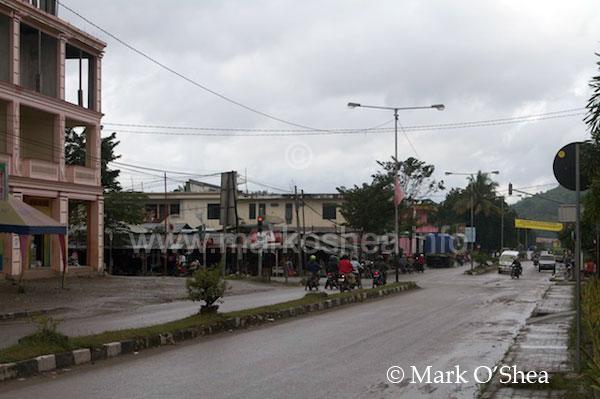
Once back in Timor-Leste, in the Oecusse exclave, we noticed a distinct deterioration in road quality.
Enroute we logged several intesting locations which we determined to search for reptiles and amphibians, not least the valleys around the confluence of the Rio Abanat, Rio Columu and Rio Tomo.
|